When a disaster strikes and the power grid fails, your smartphone goes dark, and internet access disappears, a battery-powered NOAA weather radio may be the only thing connecting you to life-saving information. It's not dramatic—it's exactly what happened during Hurricane Katrina, the 2021 Texas winter storm, and countless other events where cell networks were overwhelmed or destroyed.
An emergency radio is arguably the most underrated preparedness item. It costs as little as $20, requires no ongoing subscription, works without internet, and can receive official evacuation orders and shelter-in-place instructions directly from the National Weather Service. Every household needs one.
We evaluated 20+ models on NOAA reception quality, power source reliability, SAME alert programming, build quality, and value to identify the best emergency radios for disaster preparedness.
Our Top 8 Picks at a Glance
| Radio | Best For | Power Sources | Price |
|---|---|---|---|
| Midland ER310 | Best Overall Portable | Battery/Solar/Crank/USB | ~$80 |
| Eton Odyssey | Best All-Band | Battery/Solar/Crank/USB | ~$53 |
| Kaito KA500 | Best Features | Battery/Solar/Crank/USB | ~$50 |
| RunningSnail Solar | Best Ultra Budget | Battery/Solar/Crank/USB | ~$17 |
| FosPower Emergency | Best Value | Battery/Solar/Crank/USB | ~$28 |
| Sangean MMR-99 AM/FM-RBDS/Bluetooth/AUX/Weather/Multi-Powered Digital… | Best Build Quality | Battery/Solar/Crank/USB | ~$78 |
| C. Crane CCRadio Solar | Best Solar Performance | Battery/Solar/Crank/USB | ~$110 |
| Midland WR400 | Best Desktop Alert | AC/Battery | ~$98 |
1. Midland ER310 — Best Overall Emergency Radio

Midland ER310
The emergency radio that preparedness experts recommend most consistently. NOAA reception, automatic weather alerts, multiple power sources, and phone charging in a tough, portable package.
Midland has been making weather radios since 1959, and the ER310 reflects that experience. It receives all 7 NOAA weather radio channels with excellent clarity, scans and sounds automatic weather alerts for your area, and packs five power sources into a rugged, compact body: AC adapter, AA batteries, built-in solar panel, hand crank, and USB charging.
The SOS emergency beacon with flashing LED light is a genuine emergency feature, not a gimmick. The USB port for phone charging is useful when grid power is down. At around $80, the ER310 delivers everything you need in an emergency radio without unnecessary complexity. This is the radio we recommend for most households.
Who it's for: Everyone. The Midland ER310 is the benchmark that all other emergency radios are compared against. It's the right choice for the majority of households.
What We Like
- Excellent NOAA reception quality
- Automatic NOAA weather alerts
- 5 power sources including solar
- USB phone charging port
- SOS beacon with LED flashlight
Limitations
- No shortwave/SW reception
- Solar charging is slow
- No backlit display
2. Eton Odyssey — Best All-Band Emergency Radio

Eton Odyssey
Eton's all-band multi-powered emergency radio adds shortwave and Bluetooth to the usual NOAA/AM/FM coverage. Solid reception, hand crank, solar, and phone charging in a rugged package.
Eton (formerly Grundig) has made shortwave and weather radios for decades. The Odyssey is their modern all-band emergency radio, and it doesn't cut corners. The NOAA reception is clear and reliable, it adds shortwave and Bluetooth, and the solar + hand crank + battery + USB combination covers every emergency power scenario.
At around $53, it's an excellent choice for a do-everything radio: keep one in your bug-out bag, give one to family members who need their own emergency radio, or run it as your main portable alongside a desktop alert radio at home.
Who it's for: Preppers who want all-band coverage including shortwave, those buying radios for different kit locations, and buyers who want Eton's reliability with modern features.
What We Like
- All-band including shortwave
- Eton brand reliability
- Clear NOAA reception
- Bluetooth and USB phone charging
- Solar + crank + battery
Limitations
- No SAME alert programming
- Pricier than ultra-budget radios
- Shortwave needs some antenna skill
3. Kaito KA500 — Best Feature-Packed Radio

Kaito KA500 5-Way Powered Emergency Radio
Shortwave bands plus NOAA plus phone charging plus solar plus crank. The most feature-complete emergency radio under $60.
The Kaito KA500 stands out by adding shortwave (SW) bands to the standard AM/FM/NOAA combination. Shortwave gives you access to international broadcasts—BBC World Service, Voice of America—during major crises where domestic broadcast infrastructure might be compromised. For those preparing for grid-down or large-scale disaster scenarios, SW adds meaningful value.
The five power sources (solar, crank, AA batteries, built-in rechargeable battery, and USB-in) are genuinely comprehensive. The reading lamp with LED is a useful bonus in power-outage situations. At $50, it's an excellent value for the feature set.
Who it's for: Preppers who want shortwave capability, those who want the most features for the price, and serious preparedness planners who think beyond local emergencies.
What We Like
- Shortwave bands for international coverage
- 5 power sources
- USB phone charging
- Built-in LED reading lamp
- Excellent value at $50
Limitations
- SAME alert programming less intuitive
- Shortwave reception requires some antenna skill
- Slightly bulkier than competitors
4. RunningSnail Solar/Crank Radio — Best Ultra Budget
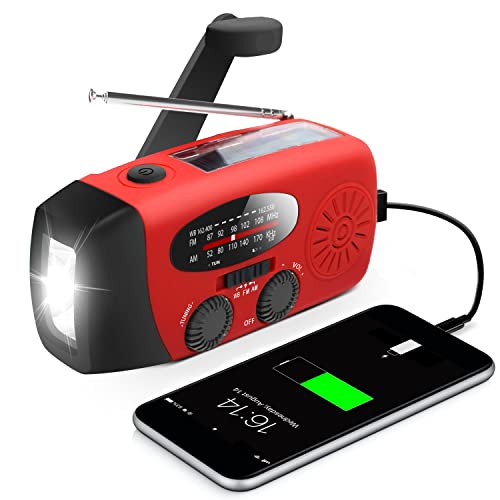
RunningSnail Solar Hand Crank Radio
All the emergency radio essentials at around $17. NOAA reception, hand crank, solar, flashlight, and a 2,000mAh power bank for phone charging.
The RunningSnail is a remarkable value at around $17: NOAA weather reception, AM/FM, hand crank, solar panel, LED flashlight, and phone charging USB port in a pocketable package. For those building emergency kits on tight budgets or who want inexpensive backups for multiple locations (car, office, bug-out bag), it covers the fundamentals without spending $40-50.
Build quality is budget-level, and SAME programming is not supported, but for a basic emergency radio that will receive NOAA weather alerts and let you manually scan local stations, it works reliably. Keep expectations calibrated to the price, and it overdelivers.
Who it's for: Those on tight budgets, anyone building multiple kit locations inexpensively, and people who want a backup radio in their car or office at minimal cost.
What We Like
- Around $17 for full features
- Solar + crank + USB
- USB phone charging included
- Compact and lightweight
- Good reception for the price
Limitations
- No SAME alert programming
- Budget build quality
- Less sensitive reception than premium brands
5. FosPower Emergency Weather Radio — Best Value Under $30

FosPower Emergency Weather Radio
Amazon's most-reviewed emergency radio for good reason. Dependable NOAA reception, multiple power sources, and a loud alarm at an unbeatable price.
The FosPower has accumulated tens of thousands of Amazon reviews with consistently positive feedback on one key metric: it actually works when needed. The 2,000mAh internal battery provides meaningful runtime, the NOAA reception is clear, and the loud emergency alarm is genuinely loud enough to wake a sleeping household.
At under $30, it's near the lowest price point at which we can confidently recommend an emergency radio. Yes, the RunningSnail is similar, but the FosPower's slightly better build quality and proven track record across thousands of user reports makes it the go-to recommendation at the bottom of the budget spectrum.
Who it's for: Anyone who needs an emergency radio at the lowest possible price. Also excellent as a stocking stuffer or gift for family members who haven't yet prepared.
What We Like
- Under $30 price point
- 2,000mAh battery is substantial
- Loud emergency alarm
- Proven track record (thousands of reviews)
- Solar + crank + USB
Limitations
- No SAME alert programming
- Build quality reflects price
- Smaller solar panel
6. Sangean MMR-88 — Best Build Quality

Sangean MMR-88 AM/FM/NOAA Emergency Radio
Sangean's Taiwanese engineering applied to emergency radio. The best-built hand-crank radio in its class, designed to survive the abuse of a real emergency.
Sangean has built high-quality radios since 1974 and brings genuine manufacturing expertise to the emergency radio category. The MMR-88 has a build quality noticeably above most competitors—the crank mechanism is smooth and robust, the housing feels like it would survive being dropped on concrete, and the controls have a quality feel that budget radios lack.
Automatic NOAA weather alerts are supported and reliable. The IPX4 water resistance rating means it can handle rain splashing—relevant during exactly the weather events when you'd need it most. The USB-A charging port for phones and the bright LED flashlight add practical emergency utility.
Who it's for: Those who prioritize build quality and expect to use their radio in rough conditions. The radio that will still work reliably 10 years from now when stored in a kit.
What We Like
- Highest build quality in its class
- IPX4 water resistance
- Reliable automatic weather alerts
- Smooth, durable crank mechanism
- Excellent reception across all bands
Limitations
- No shortwave bands
- ~$78 is mid-premium pricing
- No SAME county programming
7. C. Crane CCRadio Solar — Best Solar Performance

C. Crane CCRadio Solar Portable Radio
Built by one of the most respected names in radio. The CCRadio Solar prioritizes solar charging performance and adds Bluetooth and phone charging to NOAA/AM/FM.
C. Crane is a well-respected name in the radio enthusiast community, known for their premium designs and deep understanding of radio performance. The CCRadio Solar has a large solar panel and an efficient charging system, which translates to meaningfully faster solar recharging—critical during extended power outages where you're relying on solar as your primary power source.
The radio reception quality is excellent across AM, FM, and NOAA weather bands, and it adds Bluetooth playback and a USB phone-charging port. The build quality reflects C. Crane's standards. For those who expect to rely on solar charging as their primary power source, the CCRadio Solar is hard to beat.
Who it's for: Preppers who will rely on solar as their primary radio power source, those in areas with good sun exposure during emergencies, and quality-focused buyers who want C. Crane's reputation behind their emergency gear.
What We Like
- Large solar panel for fast charging
- C. Crane quality reputation
- Excellent reception quality
- Bluetooth and USB phone charging
- Solar + crank + battery
Limitations
- ~$110 is premium pricing
- Heavier than compact crank radios
- No SAME alert programming
8. Midland WR400 — Best Desktop Weather Alert Radio
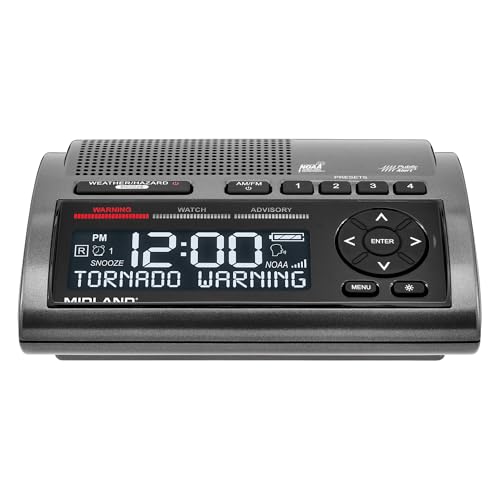
Midland WR400 Deluxe Desktop Weather Alert Radio
The loud, dedicated weather alert radio for your home. Stays plugged in, monitors continuously, and wakes the entire house when a tornado warning is issued at 3 AM.
A portable hand-crank radio is your outage companion. The Midland WR400 is your always-on home guardian. It stays plugged in, continuously monitors NOAA weather radio frequencies, and triggers an ear-splitting alarm the moment a watch, warning, or advisory is issued for your county. This is how people get woken up by tornado warnings at 3 AM—not by their phones, which may be silenced.
The SAME programming is the most comprehensive of any radio we've reviewed: you can program up to 25 county codes, display text alerts on the backlit screen, and set different alert types to different volume levels. The battery backup ensures it keeps working during brief power outages before you switch to your portable radio.
Who it's for: Every home in tornado, hurricane, or severe weather areas. This is the plug-in complement to your portable hand-crank radio. They serve different purposes and every prepared household should have both.
What We Like
- Continuous monitoring while plugged in
- Wake-up alarm for nighttime warnings
- SAME programming for 25 counties
- Text display shows alert details
- Battery backup for brief outages
Limitations
- Not portable (designed for outlet use)
- No hand crank or solar
- ~$98 is the most expensive on our list
Buyer's Guide: Choosing the Right Emergency Radio
The Two-Radio Strategy
For maximum protection, use two types of emergency radios:
- Desktop NOAA alert radio (Midland WR400): Stays plugged in at home, monitors 24/7, wakes you during nighttime weather emergencies. This protects you when you're asleep and unaware.
- Portable hand-crank radio (Midland ER310 or similar): Goes in your emergency kit, works during power outages, charges from solar or crank. This is your information lifeline when the grid is down.
SAME Alert Programming: Don't Skip This
SAME (Specific Area Message Encoding) lets you program your specific county FIPS code so you only receive alerts for your exact location. Without SAME, your radio may sound alerts for storms affecting counties hours away. Look up your county FIPS code at NOAA.gov and program it into any SAME-capable radio as the first thing you do.
Power Sources: What You Actually Need
- Battery backup: Essential. Use lithium AA batteries for longest shelf life in storage.
- Solar: Genuinely useful for multi-day outages; larger panels charge faster.
- Hand crank: Last resort power; generates only 10-20 minutes of listening per 2 minutes of cranking.
- USB charging port: Useful for phone charging if your power station is also depleted.
Cell Phones Are Not Reliable Emergency Communication
During major disasters, cell towers become overloaded or damaged within hours. The 2017 Hurricane Harvey and 2021 Texas freeze both saw widespread cellular network failures. NOAA weather radio operates independently of cellular infrastructure and continues broadcasting through the most severe events.
Frequently Asked Questions
What is a NOAA weather radio and do I need one?
NOAA Weather Radio All Hazards broadcasts continuous weather information from National Weather Service offices. During disasters, it's often the first and most reliable source of official warnings and evacuation orders. Yes, every household should have one with battery and hand-crank backup power.
What bands should an emergency radio cover?
A good emergency radio should receive NOAA/WX weather bands (7 channels), AM (domestic news), FM (local broadcasts), and ideally shortwave for international coverage during major crises. SAME filtering prevents alert fatigue by limiting alerts to your county.
What is the difference between SAME and regular weather alerts?
Without SAME, you receive all weather alerts for every county in your region, which can mean dozens of nighttime interruptions. With SAME, you program your county FIPS code and only receive alerts for your exact location. SAME makes the difference between a useful radio and one you shut off in frustration.
How effective is the hand crank on emergency radios?
A 2-minute crank provides approximately 10-20 minutes of listening time. The crank is useful for topping up a depleted battery or getting a short update, but it's not a primary power source. Use solar and battery as your primary sources, with crank as last resort.
What is the best radio for severe weather?
For severe weather specifically, the Midland WR400 is the best dedicated weather alert radio—it stays plugged in and wakes you during nighttime warnings. For a portable all-purpose radio, the Midland ER310 combines excellent weather reception with multiple power sources and phone charging.
Can an emergency radio charge my phone?
Yes, many modern emergency radios include USB ports for phone charging. The Midland ER310, Kaito KA500, and Sangean MMR-88 all include USB charging. The hand crank or solar panel charges the internal battery, which then charges your phone—a useful feature when all other power sources are depleted.
Should I get a portable or desktop emergency radio?
Ideally both. A desktop NOAA alert radio stays plugged in at home monitoring continuously, waking you during nighttime warnings. A portable hand-crank radio goes in your emergency kit for power-outage situations. They serve different purposes; serious preparedness benefits from having both.
What frequency do emergency broadcasts use?
NOAA Weather Radio broadcasts on 7 VHF frequencies between 162.400 and 162.550 MHz (WX1-WX7). Emergency Alert System (EAS) broadcasts are transmitted over AM and FM stations. Most major broadcast stations are required EAS participants for Presidential and imminent threat alerts.
Related Resources
Emergency Communication Guide
Complete emergency communication plan
Family Communication Plan
Keep your family connected in a crisis
Communication Range Calculator
Two-way radio range estimation
Best Power Stations 2026
Keep your radio charged for days
From the Creators of DisasterPrepCalc
The Complete Survival Guide for America 2026
Everything you need to protect your family — from natural disasters to grid failures. Available on Amazon.
Get the Book on Amazon →As an Amazon Associate, we earn from qualifying purchases.