Food is the third pillar of emergency preparedness (after water and shelter), but it's often the most neglected. Most families have maybe three days of food they could eat without power or a functioning grocery store. FEMA recommends a minimum 72-hour supply; serious preppers target 30-90 days.
The emergency food market has exploded in recent years, creating a confusing landscape of wildly varying quality, calorie counts, and shelf life claims. We cut through the marketing to evaluate the options that actually matter for real-world emergency preparedness: actual calorie counts, verified shelf life, taste that people will actually eat, preparation requirements, and honest value.
Use our Food Storage Calculator to determine exactly how much food your household needs for your target preparedness window.
Our Top 8 Picks at a Glance
| Product | Best For | Supply Duration | Price |
|---|---|---|---|
| Augason Farms 2-Week | Overall Best Value | 2 weeks / 1 person | ~$85 |
| Mountain House 72-Hour | Best Taste | 72 hours / 2 persons | ~$69 |
| ReadyWise 30-Day | Best Mid-Range Kit | 30 days / 1 person | ~$220 |
| Nutrient Survival | Best Nutrition | 10 servings / can | ~$58 |
| Legacy Food Storage | Best Premium | 120 servings | ~$399 |
| ReadyWise 240-Serving | Best Beginner Kit | 240 servings | ~$207 |
| Valley Food Storage | Best Clean Ingredients | 85 servings | ~$285 |
| S.O.S. Rations | Best Ultra Budget | 3 days / 1 person | ~$15 |
1. Augason Farms 2-Week Emergency Food Supply — Best Overall Value
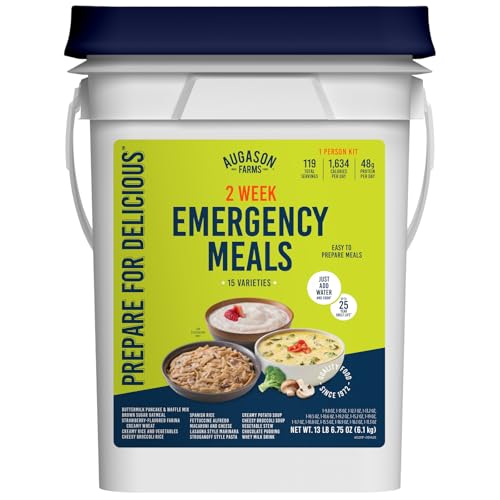
Augason Farms 2-Week Supply
One of the most popular emergency food kits in America. Two weeks of food for one adult at an honest price, with a long shelf life and genuinely edible just-add-water meals.
Augason Farms has been in the food storage business since 1972, and their emergency kits reflect decades of refinement. This 2-week kit provides 119 servings of dehydrated meals for one adult, an easy way to bridge the gap between a 72-hour kit and a full month of storage. The long shelf life is credible and well-documented.
The variety is meaningful: breakfast items, lunch/dinner entrees, and drink mixes that prevent food fatigue over an extended emergency. All meals require only hot water and 10-15 minutes of preparation, which means you need some means of heating water (camp stove, Sterno, etc.).
Who it's for: Anyone building their first serious emergency food supply. The best combination of value, quality, and proven reliability at the ~$85 price point. Buy multiples to scale up to 30 days or more.
What We Like
- Brand with 50+ years in food storage
- Long, well-documented shelf life
- 119 servings per kit
- Good meal variety prevents food fatigue
- Compact single-pail storage
Limitations
- Requires water for rehydration
- High sodium content
- Some meals less palatable than others
2. Mountain House 72-Hour Emergency Food Supply — Best Taste

Mountain House 72-Hour Emergency Food Supply
The gold standard in freeze-dried taste. When your family is stressed and scared, food that actually tastes good matters enormously.
Mountain House is the undisputed leader in freeze-dried food taste. They've been refining their recipes since 1969, originally supplying the US military and Special Forces. The difference in taste quality between Mountain House and most emergency food brands is immediately apparent. Classic dishes like Beef Stroganoff and Chicken Fried Rice are genuinely enjoyable meals.
The 30-year shelf life (the longest in the industry) is backed by extensive testing. The pouches work with either hot or cold water, making them useful even in cold-water-only scenarios. The 72-hour kit provides food for two adults for three days, making it an excellent addition to any bug-out bag.
Who it's for: Those who won't compromise on taste. Excellent for 72-hour kits, bug-out bags, and as the "treat" portion of longer-term food storage. Also great for reluctant preppers who need good taste to stay motivated.
What We Like
- Best-in-class taste quality
- 30-year shelf life
- Works with hot or cold water
- Military-grade quality standards
- Resealable pouches reduce waste
Limitations
- Most expensive per calorie
- Higher sodium content
- Not a complete 30-day solution at this price
3. ReadyWise Emergency Food Supply — Best Mid-Range Kit

ReadyWise 30-Day Emergency Food Supply
Better taste than budget brands, better value than premium. ReadyWise hits the sweet spot for families building a serious food storage program.
ReadyWise (formerly Wise Company) has improved significantly in recent years. Their current 30-day kits use a combination of freeze-dried and dehydrated ingredients that deliver noticeably better taste than pure dehydrated budget brands. The variety is solid: breakfast scrambles, rice and bean dishes, pasta entrees, and drink mixes.
At approximately $220 for a 30-day, 296-serving supply, ReadyWise threads the needle between the ultra-budget options and the premium brands. The stackable bucket design makes storage organization straightforward.
Who it's for: Families who want a step up from basic budget food storage without paying Mountain House or Legacy prices. An honest middle-ground option.
What We Like
- Good taste for the price
- 25-year shelf life
- Reasonable calorie counts
- Stackable storage containers
- Wide availability and easy reordering
Limitations
- Not as tasty as Mountain House
- Some "serving" counts are misleading
- High sodium in most meals
4. Nutrient Survival — Best Nutritional Profile

Nutrient Survival Homestyle Scramble
The emergency food brand built around complete nutritional optimization. This high-protein breakfast can delivers balanced macros and micronutrients for sustained mental and physical performance.
Most emergency food brands focus on calories and shelf life. Nutrient Survival focuses on what happens to your body and mind during a prolonged crisis. Their meals are formulated by nutritional scientists to provide complete micronutrient profiles—the vitamins and minerals your immune system and cognitive function depend on when you're under extreme stress.
This matters more than most preppers realize. After 3-5 days on a typical emergency food diet, cognitive impairment and immune suppression become real concerns. Nutrient Survival's approach is more expensive per calorie, but if you have medical conditions, children, or elderly family members, the nutritional completeness is worth the premium.
Who it's for: Health-conscious preppers, families with children, anyone with chronic health conditions, and those preparing for extended emergencies where nutritional deficiency becomes a real risk.
What We Like
- Nutritionally complete formulation
- 40 essential nutrients per serving
- No artificial flavors or colors
- Excellent for vulnerable populations
- 25-year shelf life
Limitations
- Expensive per calorie
- Smaller variety of meal options
- Less widely available
5. Legacy Food Storage — Best Premium Option

Legacy Food Storage 120-Serving Bucket
The premium option for serious preppers. Higher calorie density, better ingredients, and meal variety that makes long-term storage bearable.
Legacy Food Storage earns its premium price through genuinely better ingredients, generous per-serving calories, and the kind of meal variety that makes extended emergency food use sustainable. This bucket packs 120 large entree servings and 45,720 total calories, so you can scale daily intake to your needs without supplementation.
The ingredients list is cleaner than most competitors, with fewer fillers and preservatives. Meals include hearty lunch and dinner entrees in enough variety to rotate through without serious food fatigue. The bucket design is stackable and resealable.
Who it's for: Serious preppers who want the best quality they can afford, and those planning for longer-term emergencies where food quality directly impacts morale and health.
What We Like
- 45,720 total calories per bucket
- Cleaner ingredients than competitors
- Large, hearty entree servings
- Premium food quality reduces food fatigue
- 25-year shelf life with nitrogen flushing
Limitations
- ~$399 investment
- Requires water for preparation
- Heavier and bulkier to store
6. Wise Company 1-Month Supply — Best for Beginners

ReadyWise 240-Serving Supply (Wise Company)
Simple, accessible, and widely available. A good starting point for new preppers who want to build their food storage without complexity.
Wise Company (now under the ReadyWise brand umbrella) was one of the first companies to popularize consumer emergency food kits. Their 1-month supply is widely available at Costco, Walmart, and Amazon, making it easy to find and replace. The simple bucket design and clear labeling make it genuinely beginner-friendly.
It's not the highest quality option, and the calorie counts trend lower than ideal, but as a starter kit that's accessible and affordable, it gets the job done. Many preppers use Wise as their base layer and supplement with Mountain House for better meals.
Who it's for: New preppers taking their first step into food storage. Also good as a supplemental kit when combined with other supplies.
What We Like
- Extremely widely available
- Simple, beginner-friendly design
- 25-year shelf life
- Good price-to-serving ratio
- Easy to find at retail stores
Limitations
- Lower calorie counts per day
- All-dehydrated (not freeze-dried)
- Taste is average
7. Valley Food Storage — Best Clean-Label Option

Valley Food Storage Premium Protein Bucket
Non-GMO, no artificial flavors, no hydrogenated oils. For health-conscious families who won't compromise on ingredients even in an emergency.
Valley Food Storage built their brand around the simple principle that emergency food should be made with the same ingredients you'd use in your own kitchen. No hydrogenated oils, no artificial colors or flavors, no MSG—just recognizable ingredients that happen to have a 25-year shelf life.
The taste reflects the cleaner ingredients: Valley Food Storage meals genuinely taste more like home cooking than competitor products. Their gluten-free options make them one of the few viable choices for people with celiac disease or gluten sensitivity.
Who it's for: Health-conscious preppers, families with gluten sensitivity, and those who prioritize clean ingredients in their everyday diet and see no reason to compromise in an emergency.
What We Like
- Non-GMO, clean ingredient list
- No artificial additives
- Gluten-free options available
- Better taste from real ingredients
- 25-year shelf life
Limitations
- ~$285 is a premium price
- Smaller brand, less widely available
- Some meals need longer preparation time
8. S.O.S. Rations — Best Ultra Budget / No-Cook Option

S.O.S. Rations 3,600 Calorie Emergency Food Bar
Coast Guard-approved, no water needed, no cooking required. The most disaster-resistant food option available at any price.
S.O.S. Rations exist for the worst-case scenario: you're in an emergency where you have no water, no cooking ability, and no time. US Coast Guard-approved, these calorie-dense bars require zero preparation and provide 3,600 calories per package—about 3 days of survival calories for one adult.
At around $15 per package, they're the most affordable way to ensure you have emergency calories available. They don't taste great and won't work as a primary food source for more than a few days, but as the last line of defense in your bug-out bag or car kit, nothing beats them. Every emergency kit should include at least one package.
Who it's for: Everyone. These belong in every 72-hour kit, car emergency kit, and bug-out bag regardless of your other food storage. At around $15, there's no reason not to have them.
What We Like
- No water or cooking required
- Coast Guard-approved
- ~$15 per 3-day supply
- Compact for bug-out bags
- Works in any scenario
Limitations
- Only 5-year shelf life
- Bland taste
- Not nutritionally complete for long-term
Buyer's Guide: Building Your Emergency Food Storage
Step 1: Calculate How Much Food You Need
Start with our Food Storage Calculator, which calculates by household size and target duration. The minimum target is 72 hours per FEMA guidance; most preparedness experts recommend 2-4 weeks.
- Adults: 1,800-2,500 calories per day
- Children (2-12): 1,200-1,800 calories per day
- Pregnant/nursing: Add 300-500 calories per day
- Heavy physical labor during emergency: Add 500-1,000 calories per day
Step 2: Don't Trust "Serving" Counts
The single most important tip: always calculate total calories, not servings. Some brands advertise a "30-day supply" with only 1,000-1,200 calories per day per their own data. That is starvation-level intake. Always check the total calorie count on the nutrition facts panel.
Step 3: Layer Your Food Storage
Build your emergency food supply in layers:
- Layer 1 (72 hours): S.O.S. Rations or similar no-cook backup in your kit
- Layer 2 (2 weeks): Freeze-dried meals from Mountain House or Augason Farms
- Layer 3 (30+ days): Bulk staples (rice, beans, oats, canned goods) for longer emergencies
Storage Requirements
Heat Destroys Shelf Life
Freeze-dried food stored at 90°F will last only a fraction of its stated 25-year shelf life. Store emergency food in the coolest, driest part of your home. Ideal storage temperature is 55-75°F. Avoid garages, attics, and cars where temperatures spike seasonally.
Frequently Asked Questions
How much emergency food do I need per person?
FEMA recommends a minimum 72-hour supply. Most experts recommend 2 weeks minimum, with 30 days for serious preparedness. Adults need 1,800-2,500 calories per day. Use our Food Storage Calculator for a precise household recommendation.
How long does emergency food last?
Freeze-dried meals (Mountain House, Augason Farms) typically last 25-30 years sealed. Dehydrated foods last 15-25 years. MREs last 5-7 years. S.O.S. Rations last 5 years. Store in a cool, dry location for maximum shelf life.
What emergency food is best for dietary restrictions?
Nutrient Survival and Valley Food Storage offer gluten-free options. ReadyWise has some vegetarian choices. For severe allergies, building a custom supply from whole foods you know are safe may be more reliable than pre-packaged kits with potential cross-contamination.
Do emergency food kits require water to prepare?
Most freeze-dried and dehydrated emergency meals require 1-2 cups of water per meal. S.O.S. Rations and canned goods can be eaten without water. Plan extra water storage for meal preparation beyond your drinking water needs.
What are actual calorie counts in emergency food kits?
Always verify total calories, not just "servings." Some kits advertise "30-day supply" but provide only 1,000-1,200 calories per day. That's below maintenance level. Look for products specifying total daily calories of 1,800+ per adult per day.
Can I store emergency food in a garage?
Not recommended. Extreme heat dramatically reduces shelf life. Store emergency food in the coolest, driest part of your home, ideally at 55-75°F. Basements are ideal. Avoid garages, cars, or attics where temperatures fluctuate widely.
How does freeze-dried compare to dehydrated food?
Freeze-dried food retains 98% of nutritional content and rehydrates in minutes with cold or hot water. Dehydrated food uses heat removal, reducing some nutrients, and typically requires hot water. Freeze-dried generally tastes better but costs more per calorie.
What emergency food can be eaten without cooking?
S.O.S. Rations are designed for no-prep eating. Canned goods (beans, tuna, soup) need no preparation. For a no-cook emergency kit, combine S.O.S. Rations, canned goods, peanut butter, crackers, trail mix, and protein bars.
Related Resources
Legacy 120 Serving Review
45,720 calories, and what that buys
VEVOR Freeze Dryer Review
Preserve your own, if you actually will
Food Storage Calculator
Calculate food needs for your household
Food Calories & Quantities Reference
Calories per person by duration
Survival Calorie Calculator
Daily calories needed in an emergency
Long-Term Food Storage Guide
Build a complete food storage program
Best Emergency Water Filters
Ensure safe water for food prep
From the Creators of DisasterPrepCalc
The Complete Survival Guide for America 2026
Everything you need to protect your family — from natural disasters to grid failures. Available on Amazon.
Get the Book on Amazon →As an Amazon Associate, we earn from qualifying purchases.