The best dual fuel generator for most homes is the Westinghouse 12500-watt dual fuel generator: 9,500 running watts on gasoline and 8,500 on propane, remote electric start, and a transfer switch ready 30-amp outlet. If your needs are smaller, the Westinghouse 6500-watt covers a refrigerator, a furnace fan, a sump pump and lights.
A dual fuel generator can burn gasoline or propane, which matters in an outage. Gasoline goes stale in storage and runs out at the pump when everyone is looking for it, while propane stores for years in a tank. This guide compares six dual fuel models from the point of view of an emergency plan: how many running watts you actually get on each fuel, whether it works with a transfer switch, and how long it runs. Use the generator size calculator first, so you know the number of watts you are shopping for.

Westinghouse 12500-Watt Dual Fuel Home Backup Generator
9,500 running watts on gasoline, 8,500 on propane, with remote start and a transfer switch ready outlet.
Dual Fuel Generators at a Glance
| Generator | Type | Running watts (gas / propane) | Best for | Budget |
|---|---|---|---|---|
| Westinghouse 12500-Watt Dual Fuel Home Backup Generator | Open frame | 9,500 / 8,500 | Whole-circuit backup | Under $2,500 |
| Westinghouse 6500-Watt Dual Fuel Home Backup Generator | Open frame | 5,300 / 4,800 | Essential circuits | Under $750 |
| WEN 6800-Watt Dual Fuel Inverter Generator | Inverter | 5,100 / 4,500 | Sensitive electronics | Under $1,000 |
| Champion 4500-Watt Dual Fuel Inverter Generator | Inverter | 3,500 running | Quiet, small loads | Under $1,000 |
| Champion 4000-Watt Dual Fuel RV Ready Inverter Generator | Inverter | 3,000 / 2,700 | Small essentials | Under $1,000 |
| WEN DF475T 4,750-Watt Dual Fuel Generator | Open frame | 3,800 / 3,500 | Budget backup | Under $500 |
Watt figures come from the manufacturer listings on Amazon. Budget tiers are planning estimates, so check the live price.
Why choose dual fuel for emergency power
Fuel supply is the weak point of most backup plans. A gasoline-only generator is only as good as the gas you have stored, and stored gasoline degrades in months unless treated. Propane does not spoil, and a 20-pound cylinder is easy to keep. A dual fuel generator lets you start on whatever you have: store propane for the long term and keep a few gallons of gasoline as a second source. The trade-off is that propane output is lower than gasoline, usually by 10 to 15 percent, so size the generator for the propane number.
Dual fuel is also the best fit for a house that has a propane grill, or a larger tank, because you can run from the tank. See our propane runtime calculator for how long a cylinder lasts at your load.
How to size one
Add up the running watts of everything you want powered at once, then add the starting surge of the biggest motor, usually a refrigerator, a sump pump or an air conditioner. A refrigerator, furnace blower, sump pump, lights and phone chargers fit within about 3,000 to 4,000 running watts. Add a well pump or central air and you move to 6,000 to 9,000 watts. Our generator runtime calculator and whole house generator calculator do the math with your appliances.
How we picked
We chose dual fuel generators that are in stock on Amazon from established brands, spanning small inverter models to large open-frame units. Details come from the manufacturer listings and published specifications. We did not run hands-on tests, so treat run times as the manufacturers' claims. For single-fuel and general guidance, see our best portable generators and generator brand comparison.
Detailed Dual Fuel Generator Reviews
1. Westinghouse 12500-Watt Dual Fuel Home Backup Generator, Best Overall
9,500 running watts on gasoline, 8,500 on propane, with remote start and a transfer switch ready outlet.
The Westinghouse 12500 lists 9,500 running watts and 12,500 peak watts on gasoline, and 8,500 running and 11,200 peak on propane. It has remote start with a key fob plus electric and recoil start, two GFCI household outlets, a transfer switch ready L14-30R 30-amp outlet and an RV ready 14-50R 50-amp outlet, and a 457cc four-stroke engine with automatic low oil shutdown.
That much power runs a refrigerator, freezer, furnace, well pump, sump pump and lights at the same time, and some central air units. It includes a key fob, a battery charger, oil, a funnel and a tool kit, so it is ready out of the box. It is a big, heavy, loud open-frame unit, so plan on a spot outdoors well away from windows.
What We Like
- Large running watt output on both fuels
- Remote start key fob
- Transfer switch ready 30-amp outlet
- 50-amp RV outlet
Limitations
- Heavy and loud
- Needs a transfer switch or interlock for house circuits
2. Westinghouse 6500-Watt Dual Fuel Home Backup Generator, Best Mid-Size Value
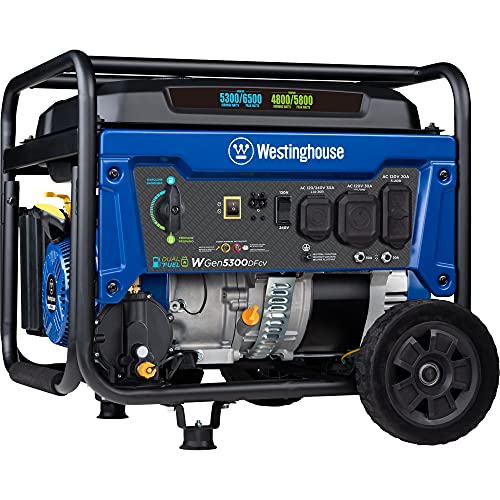
5,300 running watts on gasoline and 4,800 on propane at a mid-range cost, with CO shutdown.
The Westinghouse 6500 lists 5,300 running and 6,500 peak watts on gasoline, and 4,800 running and 5,800 peak on propane, with a 4.7-gallon fuel tank rated for up to 14.5 hours at a 50 percent load, according to the listing. Outlets are a 20-amp duplex, a TT-30R RV outlet and an L14-30R transfer switch ready outlet, and the 274cc engine has automatic low oil and carbon monoxide shutdown.
This is the size that runs a typical set of essential circuits: refrigerator, furnace fan, sump pump, lights, internet and phone charging. It includes a wheel kit, oil and a propane hose.
What We Like
- Good power for the price
- Transfer switch ready outlet
- CO and low oil shutdown
- Wheel kit included
Limitations
- Manual start only on this listing
- Open frame is loud
3. WEN 6800-Watt Dual Fuel Inverter Generator, Best Large Inverter

5,100 rated watts on gasoline, 4,500 on propane, with an inverter and a CO watchdog sensor.
The WEN 6800 is a 224cc dual fuel inverter generator that lists 6,800 surge and 5,100 rated watts on gasoline and 6,000 surge and 4,500 rated watts on propane. It has electric start, a CO Watchdog shutdown sensor, fuel shut-off, wheels and a telescoping handle, and outlets include an L14-30R, a TT-30 and 120-volt outlets.
An inverter produces cleaner power than an open-frame generator, which protects computers, medical devices and modern furnace boards. It is the pick when you want a lot of watts and clean power in one unit.
What We Like
- Clean inverter power
- CO shutdown sensor
- Electric start
- Wheels and handle
Limitations
- Heavier than small inverters
- Premium price for the watt rating
4. Champion 4500-Watt Dual Fuel Inverter Generator, Best Quiet Inverter

3,500 running watts at 61 dBA with electric start, CO Shield shutoff and parallel capability.
The Champion 4500 lists 4,500 starting and 3,500 running watts, 61 dBA noise, up to 14 hours of run time on gasoline, electric start with an EZ Start dial, an Intelligauge power meter and CO Shield automatic shutoff. An optional parallel kit, sold separately, connects it to a second Champion inverter.
It is the quiet choice for neighborhoods and apartments with an outdoor spot, and it covers a refrigerator, a furnace blower, lights and electronics. If you need more, add a second unit with the parallel kit.
What We Like
- Quiet 61 dBA
- Parallel ready
- Electric start
- Power meter
Limitations
- Smaller output
- Costs more per watt than open-frame units
5. Champion 4000-Watt Dual Fuel RV Ready Inverter Generator, Best Compact Dual Fuel Inverter

3,000 running watts on gasoline and 2,700 on propane at 64 dBA, with up to 25 hours on propane.
The Champion 4000 lists 4,000 starting and 3,000 running watts on gasoline and 2,700 running watts on propane, with up to 10 hours of run time on gasoline and up to 25 hours on propane, 64 dBA from 23 feet and CO Shield automatic shutoff. It has a TT-30R RV outlet and a duplex outlet with less than 3 percent THD.
The long propane run time is the story: a refrigerator and some lights can run for a day or more on one fill. It suits smaller homes and short outages.
What We Like
- Long propane run time
- Quiet
- CO Shield
- Parallel ready
Limitations
- Lower output
- No remote start on this listing
6. WEN DF475T 4,750-Watt Dual Fuel Generator, Best Budget

3,800 running watts on gasoline and 3,500 on propane with electric start for the lowest cost.
The WEN DF475T lists 4,750 surge and 3,800 running watts on gasoline and 4,350 surge and 3,500 running watts on propane, a selector dial for the fuel, electric start, a 4-gallon tank rated up to 11 hours at half load, and an L14-30R 120/240V outlet for a transfer switch.
It is the lowest-cost way to get dual fuel with transfer switch capability. It is an open-frame unit, so it is louder and not as clean as an inverter.
What We Like
- Lowest cost
- Electric start
- 240V transfer switch outlet
- Wheel kit included
Limitations
- Open frame, louder
- Less clean power than an inverter
Safety: never run a generator indoors
Generators produce carbon monoxide, which kills quickly and without warning. Run a generator outdoors, at least 20 feet from the house, with the exhaust pointed away from windows and doors, never in a garage or on a porch. Install battery-powered carbon monoxide alarms. Several of the models here include automatic CO shutoff, which is an added safeguard but not a substitute for placement and alarms.
Connecting to the house
To power house circuits you need a transfer switch or a code-compliant interlock kit installed by a licensed electrician, so power cannot flow back into the grid and endanger line workers. Without one, run heavy-duty extension cords to appliances. Look for a generator with an L14-30R outlet, which is the most common connection for a transfer switch.
Fuel storage and testing
Store propane cylinders upright outdoors and never in the house. Keep gasoline in approved containers with fuel stabilizer and rotate it. Run the generator for 20 to 30 minutes every few months under a load to keep the carburetor clear, and check the oil. Write the startup steps on a card taped to the generator so anyone can start it.
Frequently Asked Questions
What is a dual fuel generator?
A generator that can run on either gasoline or propane. You switch fuels with a dial or a hose connection, and the output is slightly lower on propane.
Is propane or gasoline better for emergency power?
Propane stores for years and burns cleanly. Gasoline gives more power and is easier to find. Dual fuel lets you use either.
How many watts do I need to run a house?
Essential circuits usually need 3,000 to 6,000 running watts. A whole house with central air may need 9,000 or more. Use the generator size calculator for your appliances.
Can I run a refrigerator on a dual fuel generator?
Yes. A refrigerator needs about 700 starting watts and 150 to 300 running watts, so even the smallest generator here can run it.
How long will a 20-pound propane tank last?
It depends on the load and the generator. At a half load a mid-size generator may use a 20-pound tank in several hours to a day. See the propane runtime calculator.
Do I need a transfer switch?
To power the house panel safely, yes. A transfer switch or interlock installed by an electrician prevents backfeeding. Otherwise use extension cords.
Related Tools and Guides
Generator Size Calculator
how many watts you need.
Generator Runtime Calculator
fuel use and run time.
Propane Runtime Calculator
how long a cylinder lasts.
Best Portable Generators
single-fuel and inverter picks.
Affiliate disclosure: DisasterPrepCalc is a participant in the Amazon Services LLC Associates Program. Links to Amazon earn us a commission at no cost to you. Picks come from manufacturer specifications and owner-review research, not hands-on testing. See our affiliate disclosure.