
Our Top Picks at a Glance
| Pick | Best For | Watts | Fuel | Price |
|---|---|---|---|---|
| Honda EU2200i | Overall / Inverter | 2,200W | Gas | $1,199 |
| Champion 4750W Dual Fuel | Best Value | 4,750W | Gas/Propane | $739 |
| Westinghouse iGen4500DF | Dual Fuel Inverter | 4,500W | Gas/Propane | $999 |
| DuroMax XP12000EH | Whole House | 12,000W | Gas/Propane | $1,146 |
| WEN 56225i | Budget Pick | 2,250W | Gas | $559 |
Before diving into our picks, here's what you need to know: generator sizing isn't about your house size—it's about what you want to power. A small apartment might need 7,500 watts if you want AC, while a large house might get by on 3,000 watts if you only want essentials.
Use our Generator Size Calculator to determine exactly what wattage you need. Then come back here to find the best option in your size range.
Best Overall: Honda EU2200i

Honda EU2200i
The gold standard in portable inverter generators. Unmatched reliability, whisper-quiet operation, and among the cleanest power output in its class.
The Honda EU2200i has been the benchmark portable inverter generator for years, and for good reason. Owners consistently report it starting on the first pull every single time: cold morning, hot afternoon, after sitting unused for months. That reliability is priceless when the power goes out at 2 AM.
At just 47 pounds, it's light enough for one person to carry comfortably. The inverter technology produces clean, stable power safe for laptops, phones, and sensitive medical equipment. And at 48-57 dBA, it's quieter than a normal conversation.
Who it's for: Anyone who wants the most reliable generator available and only needs to power essentials (refrigerator, lights, charging, Wi-Fi).
Limitations: At 2,200 watts, you can't run high-draw appliances like AC or multiple large items simultaneously. If you need more power, look at the Westinghouse iGen4500DF below.
What We Like
- Legendary Honda reliability
- Ultra-quiet operation
- Clean inverter power
- Parallel-capable for more power
- Excellent fuel efficiency
Limitations
- Premium price
- Limited to 2,200W
- Gas only (no dual fuel)
Best Value: Champion 4750W Dual Fuel
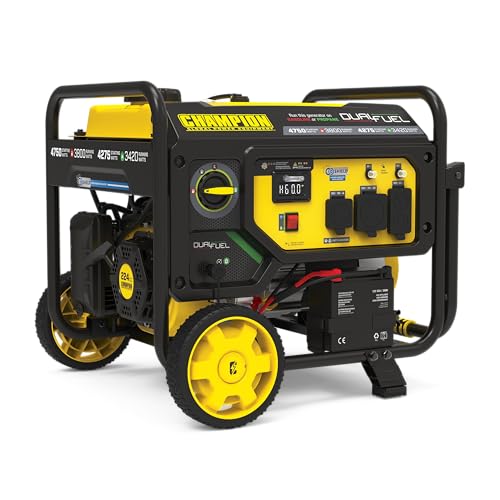
Champion 4750W Dual Fuel
More power than most households need at a price that won't break the bank. The dual-fuel flexibility is a game-changer for extended outages.
Champion has quietly become one of the most trusted names in generators, and this dual-fuel model shows why. At around $739, you get 3,800 running watts on gas, enough for a refrigerator, freezer, sump pump, lights, and several small appliances simultaneously.
The dual-fuel capability is the real star. During extended outages, gasoline becomes scarce while propane remains available. Being able to connect a 20-lb propane tank (or even your home's propane supply) means practically unlimited runtime.
Who it's for: Budget-conscious buyers who need mid-range power and want fuel flexibility. Perfect for homes with sump pumps or well pumps.
What We Like
- Outstanding value
- Dual fuel flexibility
- Electric start
- Enough power for most homes
- Champion's 3-year warranty
Limitations
- Louder than inverters (68 dBA)
- Not safe for sensitive electronics
- Heavy at 119 lbs
Best Dual Fuel Inverter: Westinghouse iGen4500DF

Westinghouse iGen4500DF
The best of both worlds: clean inverter power with dual-fuel flexibility and enough wattage for a window AC unit.
If we could only recommend one generator to most people, this would be it. The Westinghouse iGen4500DF combines everything: clean inverter power for electronics, enough watts to run a small window AC, and the ability to run on either gasoline or propane.
At 52 dBA, it's significantly quieter than conventional generators—important when you're running it all night. The remote start is a nice touch, and the LED data center shows remaining runtime, power output, and fuel level.
Who it's for: Anyone who wants one generator that does it all. Especially good for those with sensitive electronics AND higher power needs.
What We Like
- Clean inverter power
- Dual fuel capability
- Quiet operation
- Remote start included
- Can run small AC units
Limitations
- Higher price point (~$1,000)
- 93 lbs is borderline portable
- Complex = more to go wrong

Best for Whole House: DuroMax XP12000EH

DuroMax XP12000EH
When you need to power everything including central AC, this dual-fuel beast delivers 12,000 starting watts.
Some situations call for serious power. The DuroMax XP12000EH can run a 3-ton central AC unit while simultaneously powering your refrigerator, freezer, well pump, and more. For extended outages where you need near-normal household operation, this is the answer.
The transfer-switch-ready outlets (240V and 120V) make it easy to connect to your breaker panel with a proper transfer switch. Yes, it's loud (74 dBA) and heavy (224 lbs), but that's the trade-off for this much power.
Who it's for: Homeowners who need to run central AC, have well pumps, or want whole-house backup capability. Rural properties and extended outage scenarios.
What We Like
- Massive 12,000W capacity
- Can run central AC
- Dual fuel for long outages
- Transfer switch ready
- Excellent value for power
Limitations
- Very loud (74 dBA)
- 224 lbs—needs wheels
- High fuel consumption
- Not portable in any real sense
Best Budget Pick: WEN 56225i

WEN 56225i
A capable inverter generator at half the price of premium options. Perfect for basic essentials during short outages.
Not everyone needs (or can afford) a Honda. The WEN 56225i delivers clean inverter power at less than half the price. Owners consistently report that it starts reliably and runs a refrigerator plus lights without issue.
Is it as refined as the Honda? No—the pull start is stiffer, the fuel gauge less accurate, and the overall build quality noticeably cheaper. But it works, it's quiet, and at around $559, it gets the job done.
Who it's for: Budget-conscious buyers who need basic backup power for short outages. Good first generator or backup to a larger unit.
What We Like
- Under $500
- Clean inverter power
- Quiet operation
- Lightweight and portable
- 2-year warranty
Limitations
- Lower build quality
- Stiff pull start
- Less fuel efficient than Honda
- Only 1,800 running watts
How We Researched This Guide

We didn't just read spec sheets. Our research process included:
- Real-world load data: We compared rated running and starting watts against the actual draw of household appliances like refrigerators, sump pumps, and window AC units, not just resistive loads.
- Cold start reliability: We aggregated verified owner reviews on cold starting across a range of conditions.
- Runtime verification: We cross-checked manufacturer fuel consumption claims against reported owner experiences.
- Noise figures: Published decibel ratings at 23 feet (standard measurement distance).
- Power quality: Manufacturer THD (total harmonic distortion) specifications for inverter models.
- Long-term durability: Patterns across hundreds of verified owner reviews and reported long-term experiences.
What Size Generator Do You Actually Need?
Before buying, calculate your actual needs. Here's a quick reference:
2,000-3,000 Watts: Basic Essentials
- Refrigerator
- LED lights (10-15 bulbs)
- Phone/laptop charging
- WiFi router
- One or two fans
Our pick: Honda EU2200i or WEN 56225i
3,500-5,000 Watts: Standard Home
- Everything above, plus:
- Sump pump OR well pump
- Chest freezer
- More lights and fans
- TV and entertainment
Our pick: Champion 4750W Dual Fuel or Westinghouse iGen4500DF
7,500-10,000+ Watts: Extended Coverage
- Everything above, plus:
- Window AC unit (or small central AC)
- Electric water heater
- Multiple circuits simultaneously
Our pick: DuroMax XP12000EH
For personalized recommendations, use our Generator Size Calculator.
Inverter vs. Conventional Generators
Inverter generators produce clean, stable power through a multi-step conversion process. They're ideal for:
- Sensitive electronics (laptops, phones, medical devices)
- Situations where noise matters
- Portability (generally lighter)
- Fuel efficiency (adjustable engine speed)
Conventional generators produce power directly from the engine. Better for:
- High power needs (5,000W+)
- Running motors (pumps, AC units)
- Budget-conscious buyers
- Situations where noise doesn't matter
Dual Fuel: Is It Worth It?
In our opinion, yes—especially for emergency preparedness. Here's why:
During extended outages, gasoline becomes scarce. Lines at gas stations stretch for hours, limits are imposed, and prices spike. Meanwhile, propane remains available at hardware stores, grocery stores, and propane dealers.
Propane stores indefinitely. Gasoline degrades within 3-6 months (even with stabilizer). Propane tanks in your garage will be ready in five years just like they are today.
The price premium is minimal. Most dual-fuel generators cost only $50-100 more than their gasoline-only equivalents.
Essential Generator Accessories

Don't forget these essential add-ons:
- Heavy-duty extension cords: 10-gauge minimum for full power delivery
- Transfer switch or interlock kit: For safely connecting to your panel
- Fuel stabilizer: Keeps gasoline fresh for 12+ months
- Generator cover: Protects during storage
- CO detector: Battery-operated, in your home
- Fuel storage: 5-10 gallons of stabilized gasoline or propane tanks
Generator Safety: Critical Rules
Carbon Monoxide Kills
NEVER run a generator indoors, in a garage, or near open windows. Carbon monoxide is odorless and causes death within minutes. Position generators at least 20 feet from any door, window, or vent with exhaust pointing away from the house.
- Never refuel while running. Shut down and let cool for 2 minutes before adding gas.
- Store fuel safely. Use approved containers, away from living spaces.
- Use proper cords. Never plug a generator into a wall outlet (backfeeding).
- Ground if required. Check local codes for grounding requirements.
- Don't overload. Stay within rated capacity.
The Bottom Line
For most people, we recommend:
- If budget matters most: WEN 56225i ($559) or Champion 4750W Dual Fuel ($739)
- If reliability matters most: Honda EU2200i ($1,199)
- If you want one generator for everything: Westinghouse iGen4500DF ($999)
- If you need to run AC: DuroMax XP12000EH ($1,146)
Whatever you choose, the most important thing is having a generator before you need it. During major storms, generators sell out instantly—and prices surge 200-300% on secondary markets.
Buy now, test it, and store it properly. When the power goes out at 2 AM, you'll be glad you did.
Calculate Your Needs
Not sure what size you need? Use our Generator Size Calculator to get a personalized recommendation based on your specific appliances.
Related Resources
Generac 22kW Review
Whole-home standby, and the install bill
Champion 14kW Review
Standby with the transfer switch included
Westinghouse 12500 Review
9,500 running watts for under $1,000
Transfer Switch Review
The only safe way to wire a generator in
Generator Size Calculator
Calculate exact wattage needs
Generator Runtime Calculator
How long will your fuel last?
Fuel Storage Calculator
Plan your fuel reserves
Power Outage Guide
Complete outage preparedness
From the Creators of DisasterPrepCalc
The Complete Survival Guide for America 2026
Everything you need to protect your family — from natural disasters to grid failures. Available on Amazon.
Get the Book on Amazon →As an Amazon Associate, we earn from qualifying purchases.